
To Order Prescription Lenses described below, go to Prescription lens ordering page.
Free Form Lens Technology
Bifocals & Progressives
Polarized
Photochromic (Transitions)
Polarized & Photochromic
Other Sports Performance Lenses


| The prices quoted on this website apply to single vision prescription lenses (pair) 6.00 diopters or less with cylinder -2.00 or less. What this means is that when you look at your prescription, you want to look at the first number across the OD/OS or Right/Left lines. If the first number is greater than 4.00 and/or the second number is greater than -2.00, your prescription will be subject to a power charge of $10. Also, if your power is over 4.00, you may want to consider high-index lens options to thin out the lens and make it more lightweight. See lens descriptions for more information.
The prices quoted also apply only to frames with a 6-base curve or less. If the frame is a 7 or 8 base curve, and additional base curve charge of $20 will be added to your order. 7 or 8 base curve frames are designated by symbol RX8. Or, the frame description may also describe the frame as having a specific curvature. To add base curve as a charge in the shopping cart, see the chart above. Please note, high base curves due tend to create some distortion in higher prescription powers (usually spherical above -4.00 and cylindrical above -1.00) If you are very sensitive to distortion, select a lesser base curve frame. Wrap frames can be made at your own risk with most prescriptions, but they are not refundable if too much distortion is created by your prescription with the curvature. In order to properly fill your prescription, we need the prescription as actually written by your doctor. You can fax us a copy of the written prescription at 888-240-6551 or e-mail it to admin@sporteyes.com. Or, you can copy it into the comment information on the order form. If you do not have your prescription available, you can give us your doctor's name and phone number and we can call and get the information for you. We also need PD (pupil distance) measurements to ensure prescription is made accurately. You can obtain your pupil distance from whomever fit your last pair of glasses. Typically, prescriptions take anywhere from 7 to 10 working days. With prescriptions, if the lens fails any inspection point along the way, lenses will need to be remade and will increase the estimated delivery time. Manufacturer direct lenses typically take 2-3 weeks. See bottom of brand page for estimated delivery times or call or email for estimated delivery times. Some brands such as Barracuda, Seavision, Tusa, and more can only be made direct from the manufacturer. See brand page for details. Delivery times are estimates and not guarantees. You can email us to request a rush, but again, we cannot guarantee a delivery time. Prescriptions are custom made products so they are not fully refundable. See return policy page for details. If the prescription is made wrong (our error) we will remake them at no charge within 30 days. Need more information? Check out the Eyeglass Guide below.
Prescription lenses can be made out of 3 main materials: Glass, CR-39 optical plastic, and impact-resistant polycarbonate. Here are the advantages/disadvantages of each material: Glass: Glass was the original material prescription lenses were made out of, however, it is now used on a limited basis. Glass offers the best optical clarity, meaning that there is virtually no distortion in glass lenses. This is why it is the material of choice in manufacturers such as Ray-Ban, Revo, Vuarnet, and Serengeti. However, glass is the least impact resistant of all of the material, and may shatter upon impact. Shattering means that the lens will split into small pieces which can easily enter the eye and cause permanent eye injuries or even blindness. Therefore, glass is not recommended for any active sports where a fall or a hit by a ball can shatter the lens. It is also the heaviest of all the materials which may limit the length of time these lenses can be worn. Also, the thickness and weight of glass increases as power increases. Therefore, those with higher prescriptions may find it uncomfortable to wear glass lenses. However, glass is the most scratch resistant of all materials. Plastic: CR-39 refers to the type of plastic that is used to make prescription lenses. This is optical plastic and provides very little distortion (more than glass but less than polycarbonate). Plastic is the most commonly used material for prescription lenses today. It is more lightweight and thinner than glass making it comfortable to wear. It is more impact resistant than glass, but may still break and shatter upon impact. Therefore, it is not recommended for active sports. It is more scratch resistant than polycarbonate, but will scratch if not properly taken care of. Polycarbonate: Polycarbonate is an impact resistant material. It is 10x's more impact resistant than regular CR-39 plastic. Most good polycarbonate can be shot at with a .38 caliber bullet and not shatter. It is becoming used more and more today especially for sports eyewear and sunglasses. Although polycarbonate is impact resistant, it should not be consider breakproof or shatterproof. However polycarbonate is the strongest material and will have the tendency to break in large pieces versus small pieces which are not as dangerous. Polycarbonate is thin and light so it is perfect for those with higher prescriptions. It is 43% lighter than CR-39 plastic. Polycarbonate does have the most distortion of any other lens material though. However, only those very sensitive to distortions will really notice it. Although tough, the material is actually softer meaning it is more susceptible to scratches. Thus, polycarbonate must be handled with care. However, better scratch resistant coatings have been created in recent years to help combat the softness of polycarbonate and make it more scratch resistant. There are higher end polycarbonate (Tegra) with "tuff" coatings that can be rubbed against sand paper without scratching. This is an aspheric lens design which is better for higher lens powers (cannot be made in RX8 frames) UV coating is also standard in polycarbonate lenses so an additional charge for UV does not need to be added. For better optical clarity, see the Trivex lenses. For scratch resistance, add the Optifog coating which includes a tough scratch coating with it. Trivex: Trivex originated in the defense industry. It is as safe as polycarbonate but offers better optical clarity (same as CR-39 plastic). They are also more scratch resistant than standard polycarbonate and is more resistant to chemicals. Trivex meets FDA and ANSI Z87.1 impact safety standards at 1.3mm. It is the lightest lens available. 100% UV protection is also standard and does not need to be added.
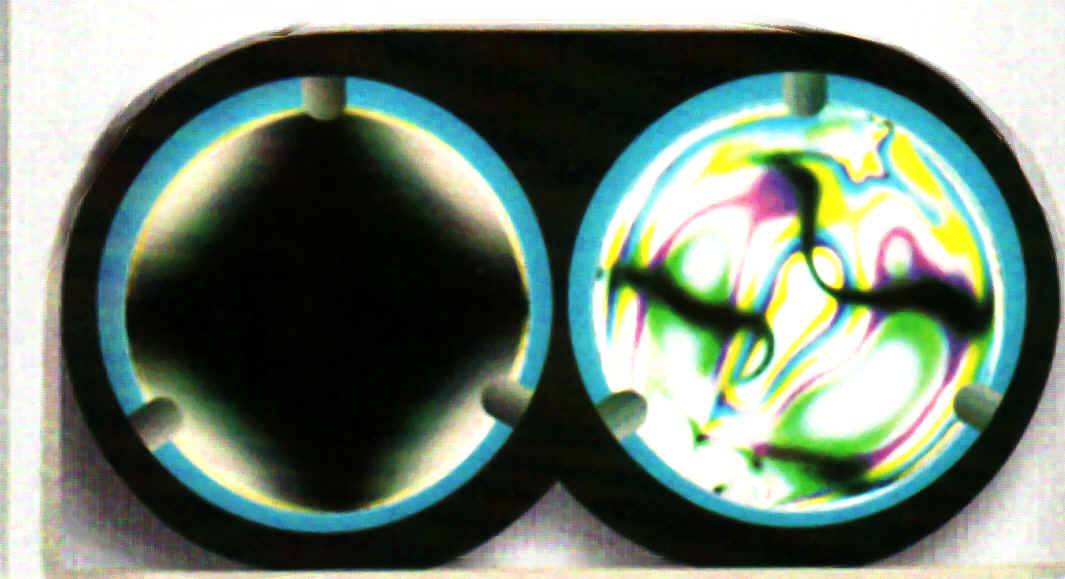
Lens comparison as viewed through an illuminated polarized lens. Phoenix brand of Trivex on left, polycarbonate on right. Notice the internal stress and distortion in polycarbonate lenses. NXT: Developed for the military, NXT lenses offer superior optics, compensate for the brightest sunlight and hold up under the harshest environmental conditions. NXT is ligher and stronger than polycarbonate. 100% UV protection built in. Available in Polarized and Photochromic lenses.
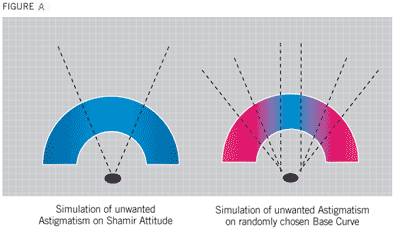
Available in all lens materials except glass. Digitally surfaced lenses are superior to conventional lenses in every way. Increased visual clarity plus cosmetic differences are especially noticeable in higher prescriptions. Free Form lenses pair lens surface topography data with proprietary mathematical algorithms that virtually eliminates unwanted astigmatism, swim and peripheral distortions by proving maximized fields of vision (20% wider fields of view in all zones). They offer the highest RX precision (up to 0.01 diopters) and virtually eliminate peripheral distortions. Each lens is created using an aspheric atoric back surface customized to the frame dimensions and fitting information specifically for you. This results in improved visual clarity and cosmetic appearance, especially in higher prescriptions. We use the Shamir Autograph II brand of Free Form lenses with our lab. Other features:
Free form lenses are more accurate because they are not made with molds. Each design starts with a spherical lens which is digitally surfaced to the exact design and prescription creating a personalized lens specially for you.
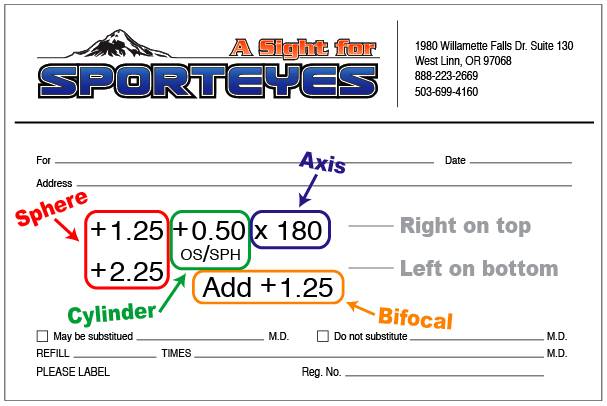
Here is an example of what your prescription from your doctor may look like. We have circled the important components of the prescription so you understand what the numbers refer to:
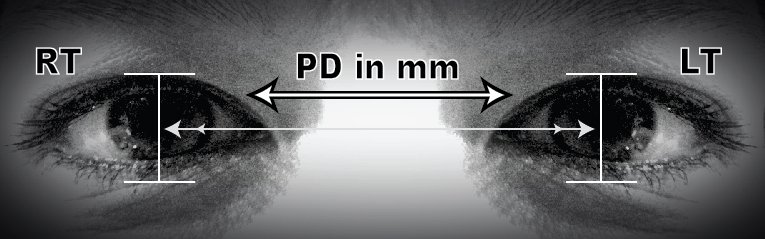
Or here is a more in depth analysis of a prescription: OD (Right) -3.50 -1.00 x90 Or R -4.50 +1.00 x180 These prescriptions are equal even though they may not look like it. Let's look at the bolded prescription first. OD refers to your right eye. OS refers to your left eye. -3.50 and -2.50 refer to the spherical part of your prescription. Your prescription may show SPH in a grid above. This is the main part of your prescription and most of your power lies here. If you are purchasing a step diopter swim goggle, you would use this number to determine what power to get. Since the swim goggles are in half diopter steps (0.50) only, you would need to consider the second number of your prescription to determine the proper power for the left eye in our example. The second number (-1.00 and -0.50 in our example) refer to the cylinder (CYL) or you may know it as your astigmatism. This means your eye is shaped more like a football instead of being round. It is like the fine tuning on a television. You can see objects, but the higher the astigmatism, the more halo affect you will have around objects. Minor astigmatism is usually not corrected in contact lenses, and thus for step diopter swim goggle purchases, would not need to be corrected either. We consider minor astigmatism anything below 1.00. Normally, with step diopter goggles, we would suggest you round down (or a -2.00 for the left eye) However, we can combine the first and 1/2 the second numbers for an "effective" power number. For the left (OS) eye, we add -2.25 and -0.25 (1/2 of 0.50) for an "effective" power of -2.50. (If you are unsure, simply copy the prescription into the comments and we will make the determination for you). If your second number (CYL) is larger than -1.00, we suggest you go into a custom made product instead of a step diopter product for the best vision. The third number is the Axis (abbreviated by the x). This is the placement of your cylinder prescription on a 0º to 180º plane. This is necessary component for all custom made prescription lenses. Now, let's look at the second (non-bolded) the prescription. R and L are used as some will use R for right and L for left instead of OS and OD. This prescription, believe it or not, is equal to the bolded prescription. Why? Today, most of the industry writes, reads, and fills prescription in minus cylinder (second number). You can see that the bolded prescription has a minus (-) sign in front of the second (cylinder) number. This is the modern way of writing prescriptions. However, some older doctors or ophthalmologists will still use plus (+) cylinder. You can see in the non-bolded prescription that there is a plus (+) sign in front of the cylinder number. If you are ordering a custom made prescription lens, you do not need to worry about this. We will make the conversion for you. However, if you are ordering a step diopter swim goggle/dive mask, you will need to make this conversion to order the proper prescription for your eyes. If you do not make the conversion, you will make the mistake of ordering -4.50 and -3.00 lenses (if your prescription reads as the non-bolded one does). Your actual prescription would read as the bolded prescription requiring -3.50 and -2.50 lenses. This is why the conversion must be made. Please note: If you have plus (+) number in front of the first number (sphere), no conversion is necessary. This just means that you are farsighted rather than nearsighted (minus prescriptions). If the first and second numbers are plus (+), then you will need to make the conversion. This conversion is simple if you understand basic algebra. Again, if you are unsure, just simply enter your prescription and we will make the determination for you. Here is how to make the conversion. Add the first and second numbers together {(-4.50) + (+1.00)=-3.50 for the right eye and (-2.75) + (+0.50)=-2.25 for the left eye}. You then just change the plus (+) sign in front of the cylinder to a minus (-) (-1.00 for the right and -0.50 for the left). This is all you will be concerned with as the placement of the axis is not necessary for step diopter goggles. However, for those interested, you would then add or subtract 90º so that it is a number between 0º and 180º (180-90=90 for the right and 20+90=110 for the left). Once you have made the conversion, you can use the same rules for determining the right strength the step diopter by adding 1/2 the cylinder to the sphere power to determine the "effective power" as described above. We also need a PD measurement in order to properly fill your prescription. This is usually not written on your prescription, but is a measurement taken by the optician filling the prescription. However, since we do not have you sitting in front of us to take the measurement, we need you to provide this information to us. A PD refers to your pupilary distance, or the distance between your pupils. Do not attempt to take this measurement yourself in the mirror. When you look in the mirror you would be taking a "near" PD as your eyes converge. You want to take a "distance" PD so you will need another person to measure this for you while you look off into the distance. It is the distance from the center of one pupil to to center of the other pupil in millimeters. (If you take it in inches we can do a conversion to mm for you). A PD ensures that the center of the lenses line up with the center of your pupils where you will get the best vision. If you don't provide one, we will use a standard unless we feel that your prescription is too high and too much distortion will be induced if we use a standard one. PD is not necessary for step diopter products. PD is usually written like this: PD=60. Or it could be split per eye like 30/30. There are also apps that you can buy from Google Play or ITunes stores to meausure as well.
Bifocals and progressives require taking very precise measurements with the glasses on your face. They are frame dependent and in order for them to work properly, we need to know where your pupil sits in the frame top to bottom. Measurements from your current glasses do no help as each pair of glasses will fit differently on the bridge of your nose. Many companies will sell you progressives online and put the "seg height" at a standard position. However, if your pupil is not centered over this spot, it will cause your prescription to be too strong, too weak or cause you to hold your head at an unnatural position causing neck cramps, or slow reaction times. Thus, we don't think it is ethical to fit progressives online. However we do have options.
Are you sure you need bifocals/progressives? Most sports utilize mostly distance vision. For fast moving ball sports like baseball, racquetball, etc. you can't move your head fast enough to get into the intermediate/near portion of the lens so paying the extra money for progressives/bifocals may not be of any benefit for you. In these circumstances, single vision is the best and least expensive option. For cyclist who need to read bike computers, you may benefit from progressives as you often switch between distance and intermediate during the ride and have time to move your head to get into the right position. Fishermen may also benefit from having full near vision to tie flies, bait hooks, etc. But most ball sports, water sports, etc., you don't need multifocal lenses. Distance only is best for these situations. Also, if you get the glasses in single vision and really decide you need to have progressives, you can always utilize our one time exchange policy and since you will have the frame in hand at this point, you can always get measured, and send the glasses back for the one time remake into progressives or bifocals.
Lenses colors are grouped into two categories: functional tints and fashionable tints. Since you are creating a custom made prescription lens, you do not need to use the lens color that the frame you choose comes with. Therefore, a frame that comes as a plano (non-prescription) sunglasses gray lens, can have a yellow prescription lens. You can also add options such as polarized or photochromatic that may not be available in the plano version. (see chart below for these options). If you are doing manufacturer direct product, the options would be limited to what the manufacturer offers on the brand page. However, we can make lenses with our lab for most full frames and do any of the color tints listed below. Please note: Tint colors will vary from lens material to the thickness of the prescription so these are sample colors. Your prescription may turn out slightly differently. CR-39 lenses will absorb tints better, but polycarbonate does come pre-tinted in both gray #4 and brown #4 for darkest available tints no matter what the prescription. Trivex will not tint as dark if that is what you are going for. Functional Tint Colors: (listed in order of popularity) Gray and Brown/Amber tints are available in grades from 1 to 4 where 1 is almost clear and 4 is a true sunglass lens. Other color tints are available in a 3 level as a standard. If you want a different level, it is available by special request. Other fashion tints such as blue, green , purple, etc. are also available by special request.
Gray on top starting at #1 on far left, #4 on far right. Brown on bottom with #1 on left, #3 in middle, and #4 on right.
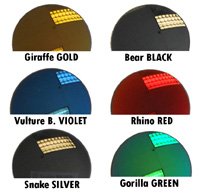
Rose on top left, yellow on top right, Serengeti brown on bottom right, green on bottom right. Fashion Tints: (available by special order only) Mirror Coatings:
Solid/Gradient Tints:
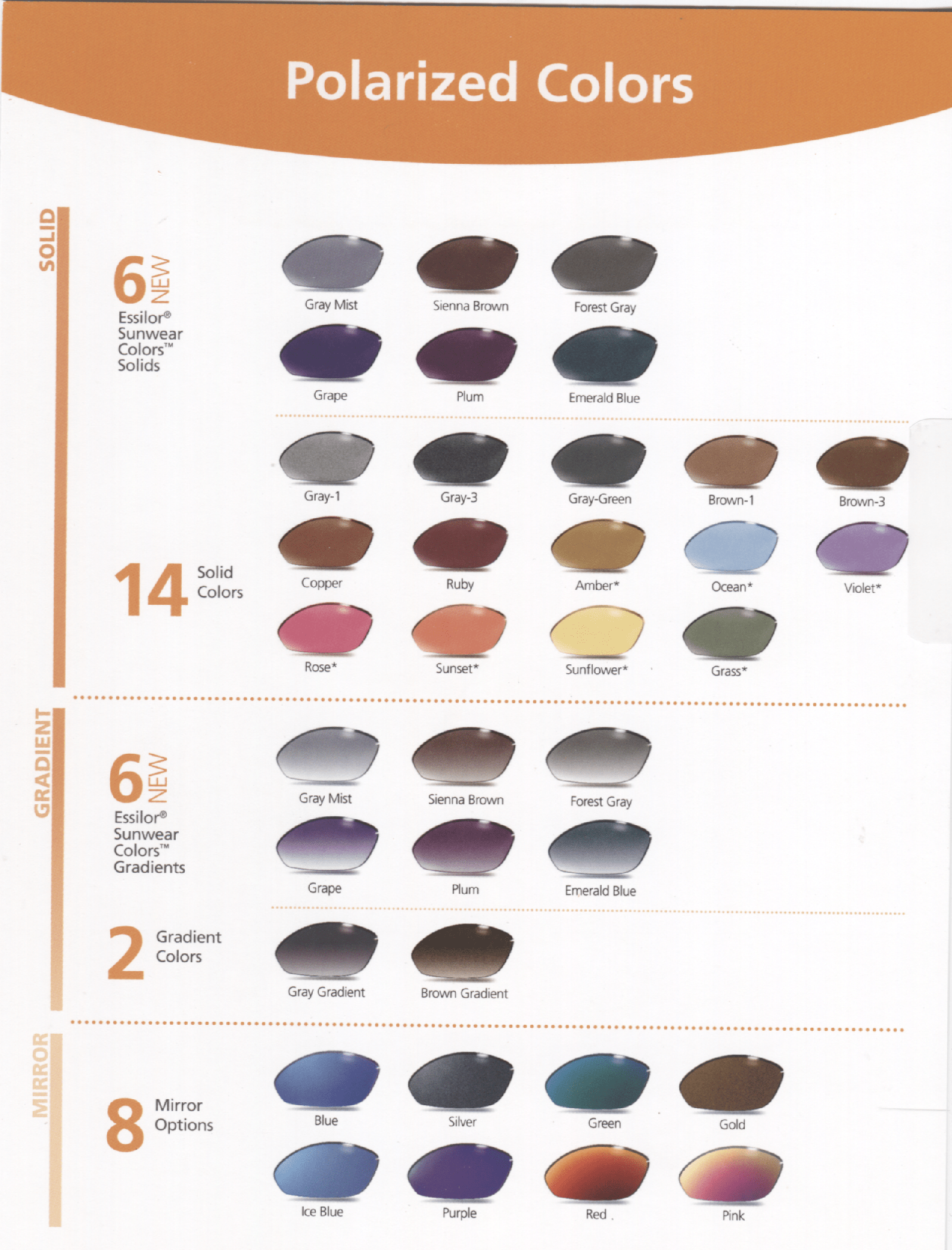
In addition to choosing the basic lens material and color, you may also choose to add some of these options to make your glasses more "high-tech". Polarized: When you wear sunglasses, do you still feel like you are squinting? One of the most popular options today is polarized lenses. In bright situations, light is often reflected off of flat surfaces such as sand, water, snow, car hoods, etc. This light manifests itself into what we call glare. Essentially, polarized lenses absorb 98% of that glare so that you don't have to squint. Your eyes are more relaxed as they do not have to deal with glare. Polarization is not a coating. It is a filter that is sandwiched between two lenses. Therefore, polarization is not something you can simply add to your existing glasses. It requires creating a whole new lens. Tint and UV are included. The most popular colors are gray or brown but we do have a full range of specialty colors available as well. For a full demo of polarized lenses, see the Xperio website (the lens we predominately use) here.
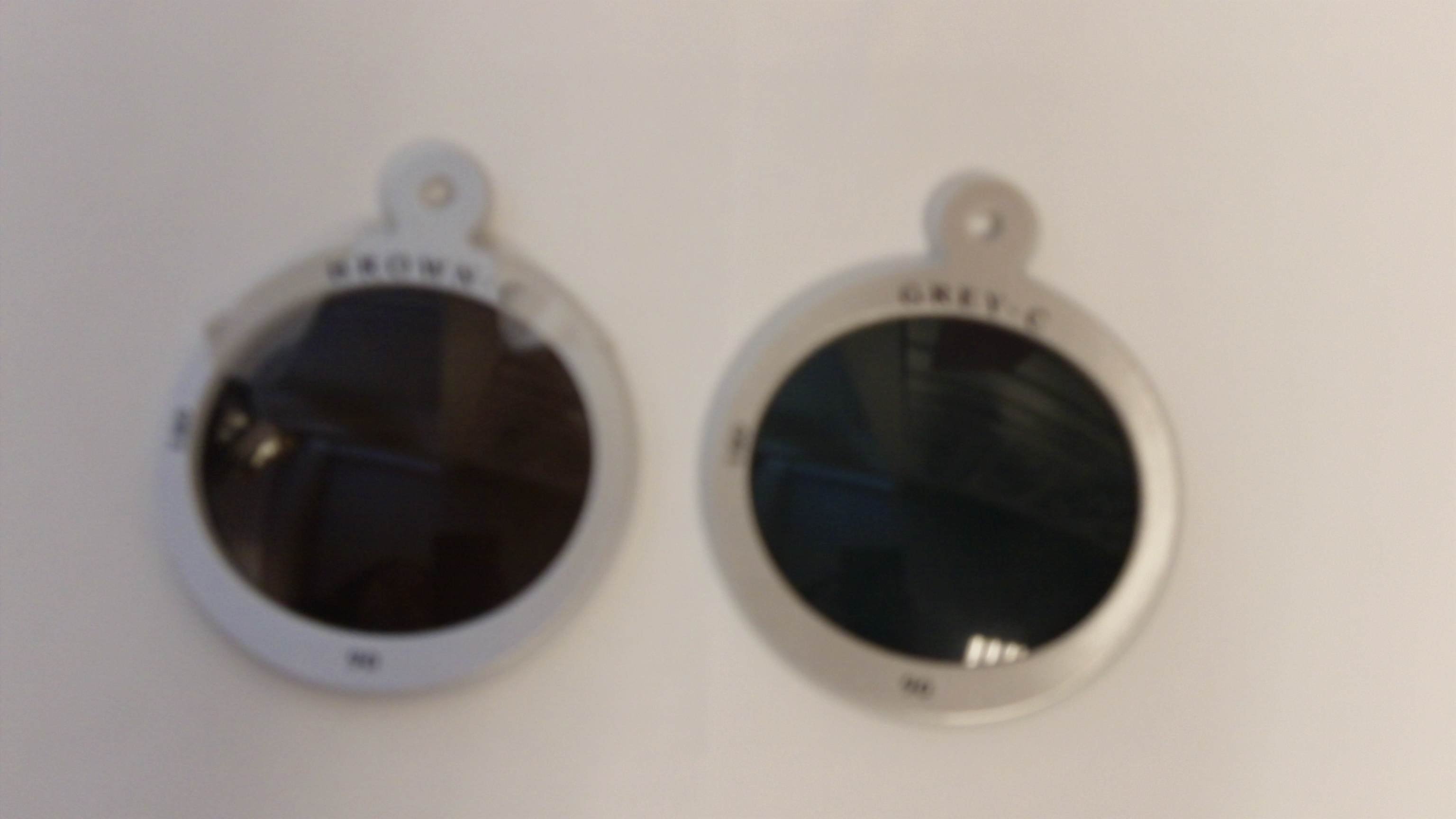
Brown on left, gray on right
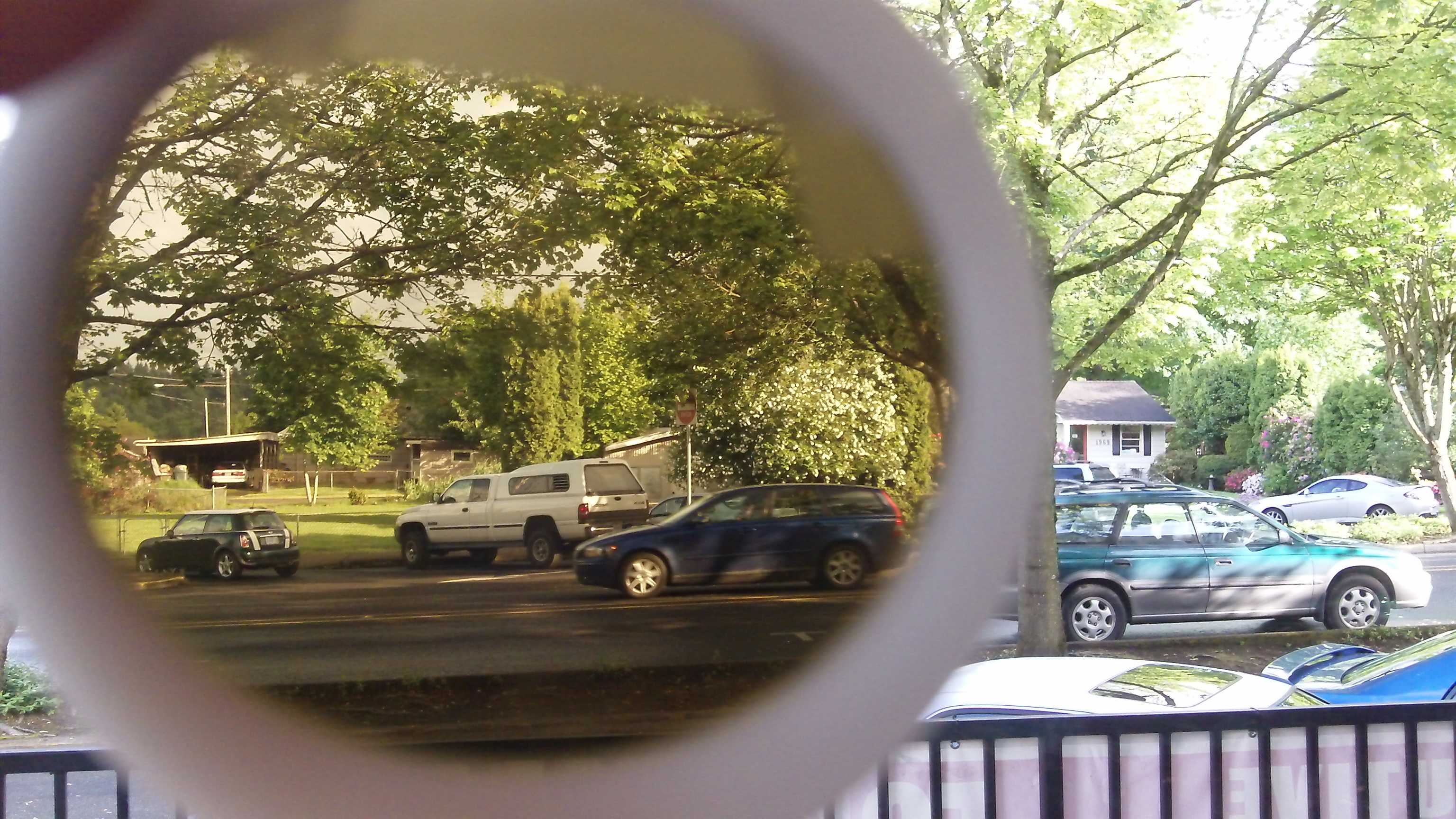
View through a brown polarized lens. Other Performance Specialty Lenses:
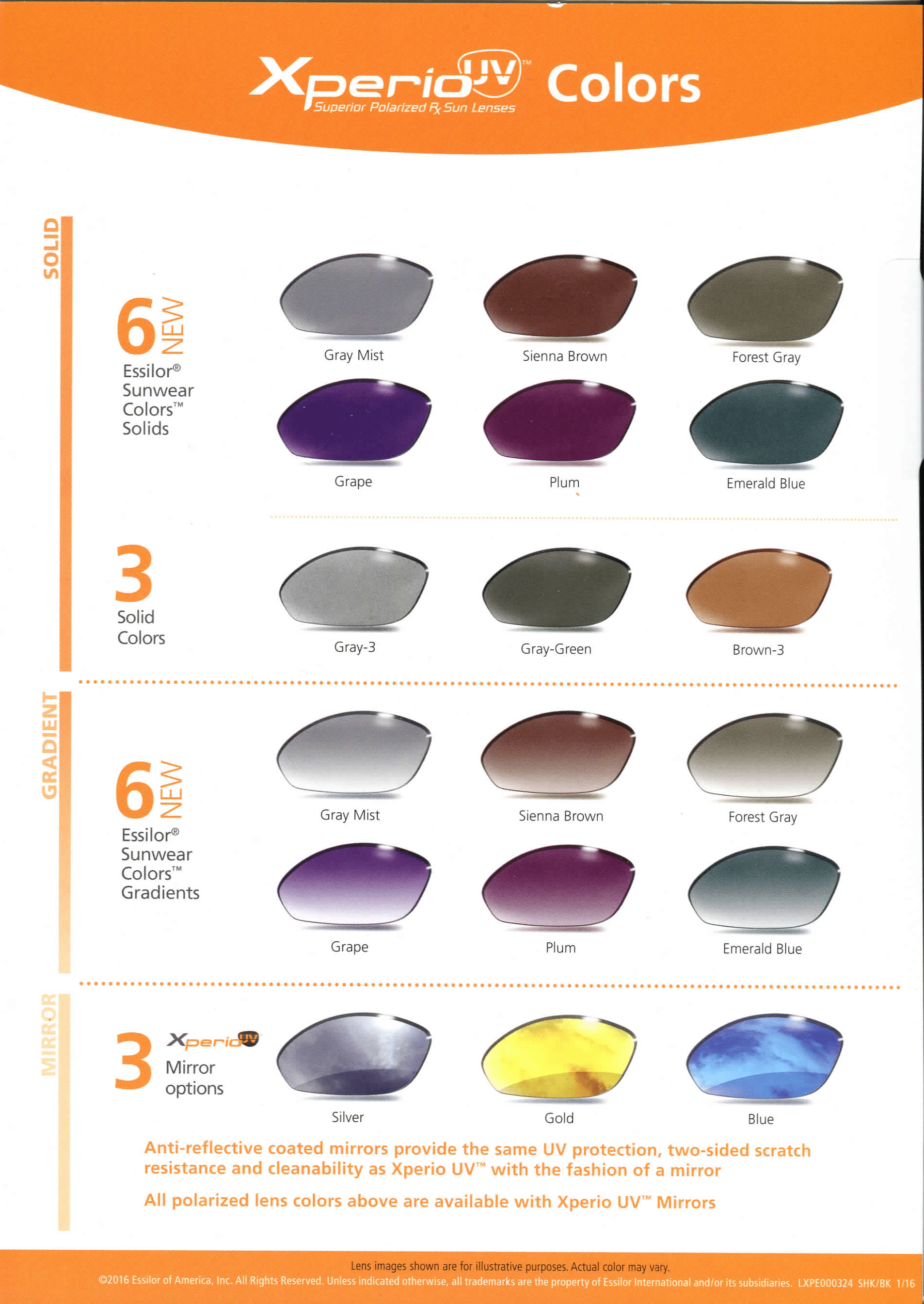
XperioUV Colors:
Standard Essilor Polarized Lens Colors
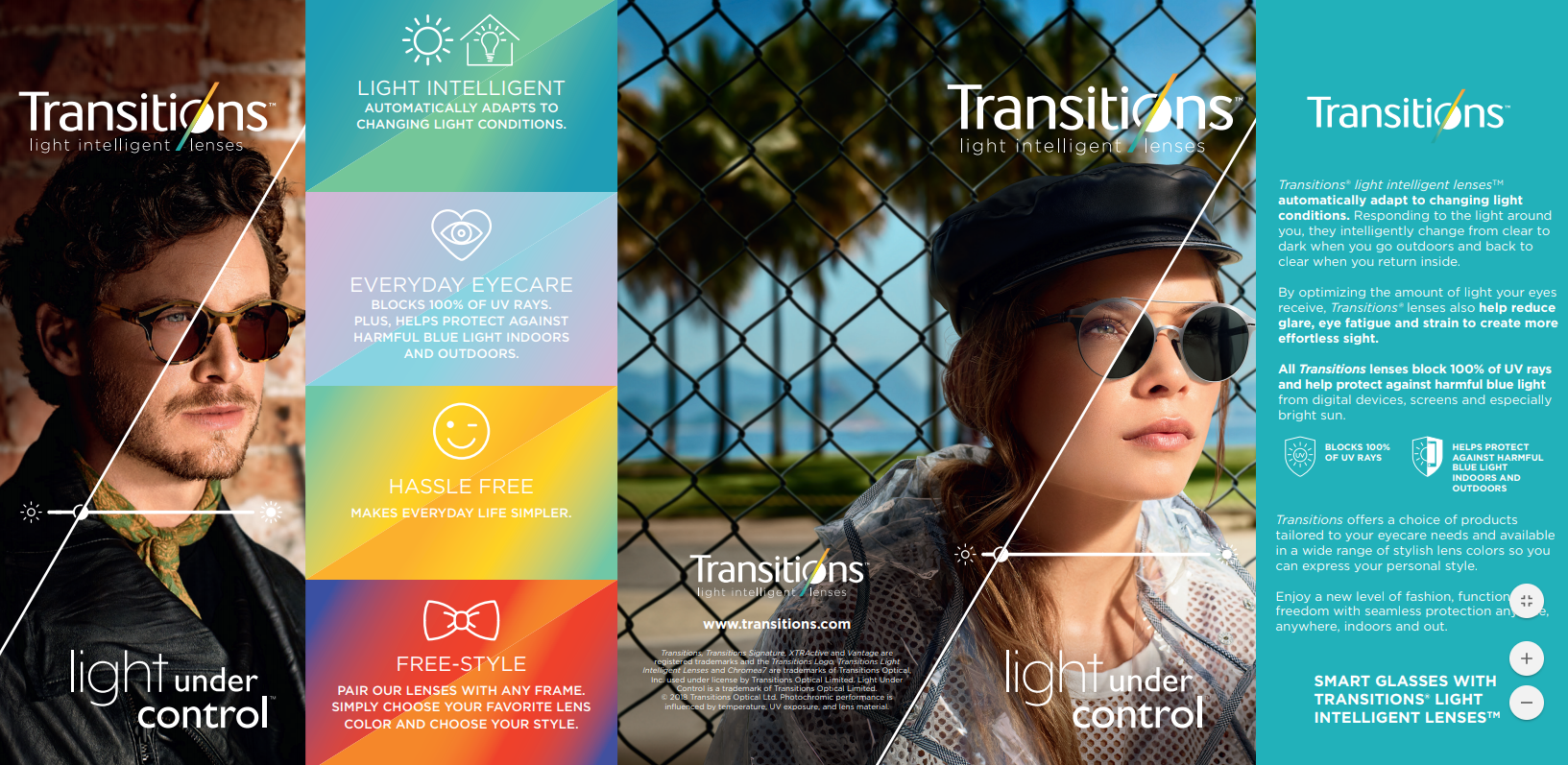
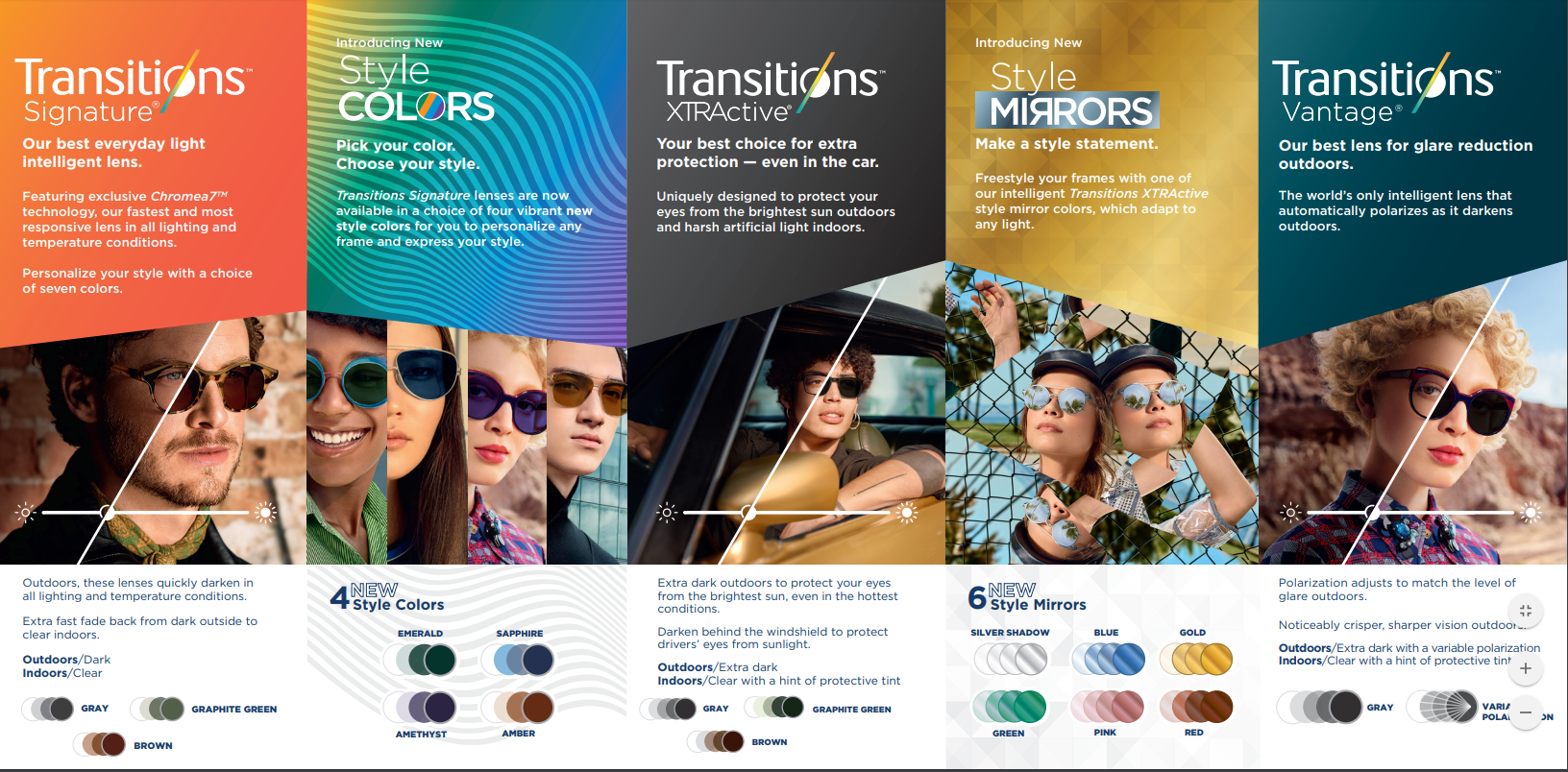
Photochromatic: Photochromatic lenses are also a new popular option. These are what people often call "changers" or "Transitions" (brand name) because they change color with varying lighting conditions. Indoors they are almost clear or lightly tinted. Outdoors, they are dark sunglass lenses. Typically most prescription photochromics change from light to dark, but some manufactures are making lenses that change from a medium tint to a dark tint. Since this limits the lenses use, we offer the photochromatics that change from nearly clear to true sunglass lens. Other types of photochromics are available by special order. Call 888-223-2669 for more information. Photochromatic lenses are useful on sports glasses if you play during the day and at night or if you play indoors and outdoors. It allows you to have one pair of prescription lenses than can be used for all lighting conditions. Please note: Photochromics do not change because of sunlight, but rather by UV rays. Therefore, they will not change while driving a car as the car windshield will block the UV rays necessary to change the lens color (note: see Drivewear lenses below for lenses that do change behind windshield). Tint and UV included. For plastic, Trivex and polycarbonate lens materials, we use Transitions® lenses (most current generation--we do not use past generations of lenses--be warned that some places may charge less because they are using previous technology. We only use the most current technology for all our lenses. As of Jan. 2014, we are using Transitions VII Signature Lenses). For glass lens materials, we use PhotoGray® or PhotoBrown® technology. There are also "NXT" lenses which is a brand of Trivex. These will go from either yellow to dark gray, medium brown to darker brown, or medium gray to darker gray. Polarized is an option in the NXT lenses as well. Transitions Xtra Active now available (polycarbonate, CR-39 plastic and Trivex only). These don't go all the way clear but get darker than regular Transitions lenses. They will have a slight tint to them in the lightest state, including behind a windshield.
Want to try out Transitions? Download the android app here to try Transitions lenses. Transitions Mobile App
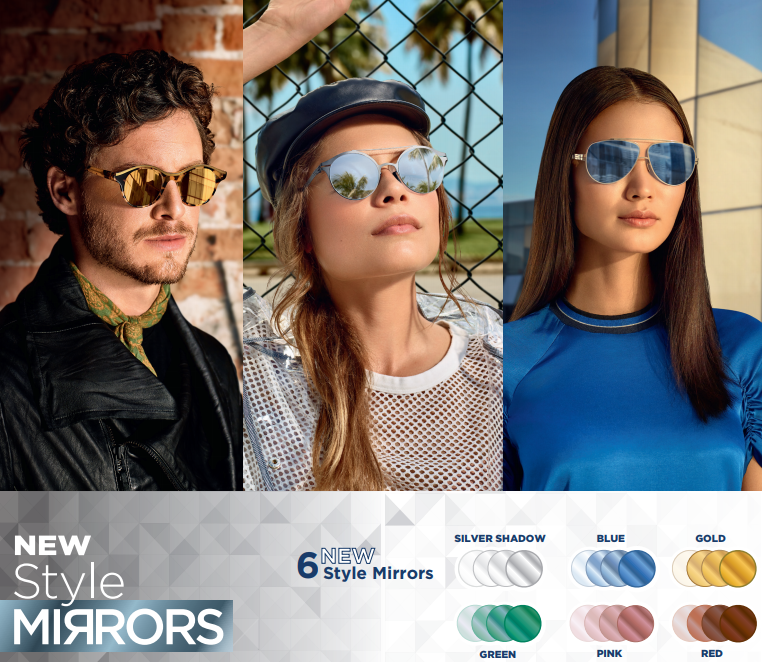
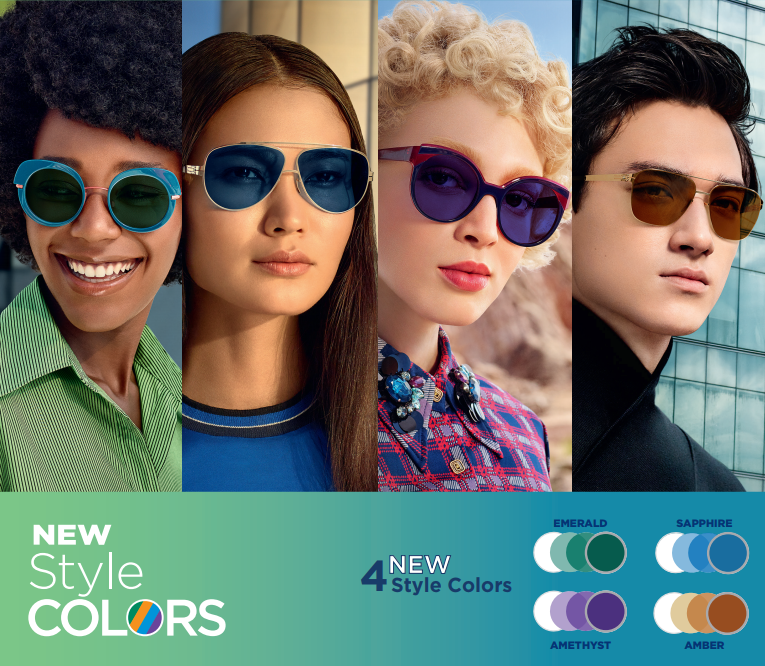
Transitions Specialty Colors: Eyewear has always been one of the timeless accessories that emboldens true self-expression. Transitions Style Mirrors take that to a whole new level. Silver Shadow. Blue. Gold. Green.Red. Pink. These dazzling mirrors unleash the wild side ofTransitions lenses. Now you can go clear to Amber. OrAmethyst. Or Emerald. Or Sapphire. You can make the jump to the comfort, light-intelligent performance, style and protection of Transitions lenses in a whole new way. And never look back.
Polarized Photochromatic: We have NXT Photochromic lenses (Trivex) and Drivewear lenses (CR-39 and Polycarbonate only). Drivewear utilizes both Transitions and NuPolar polarized lens technology. The only polarized photochromic lens that will actually darken outside as well as behind the windshield of a car. Reacts to different weather conditions from overcast to bright light by utilizing visible as well as UV light. Enhances the eyes' natural functions to provide optimum vision. High efficiency polarizer that blocks blinding glare. Blocks 100% UVA/UVB. For more information and technical details, visit www.drivewearlens.com. Note: does not go to clear like traditional Transitions lenses so these lenses should not be used for night driving. Available in powers -8.00 to +6.00 only.
Anti-Reflective Coating: Like polarized lenses, anti-reflective coatings help reduce glare. However, unlike polarized lenses, anti-reflective coatings (AR) are coatings that can be put on a lens after it has been made. When light passes through a lens, about 16% of it is reflected and bounces back into space, thus causing glare. Anti-reflective coatings allow 99% of the light to pass through the lens, thus, minimizing glare. AR is a popular lens option for regular glasses as it also has the cosmetic feature of looking like there is no lens in your glasses. However it also has the drawback of needing to be kept clean. Any dirt or fingerprints will be magnified with an AR coated lens. This is a good option for clear glasses that are used at night as artificial lighting often causes unnecessary glare. For sunglasses, a back surface AR coating is often used. It is used on the backside so that any light that comes in through the back of the lens is not reflected back into the eye. This option is highly recommended for lenses with mirror coatings as back reflectance is more noticeable with a mirror. Anti-Fog Coating: Optifog by Essilor. The Optifog product comes with either a hard scratch coating or Crizal Anti-reflective coating ($70 more--add optifog and AR together). Coating is on both sides of the lenses. This fog coating works in conjunction with an activator cloths that last for about a week. (4 cloths, each lasting 3 months included--more can be purchased). There is no distortion or loss of vision with this activator versus other spray or gel type defoggers. This includes TD2 Scratch coating with a 2 year warranty on scratches. But this coating can only be added to clear lenses. No tints or photochromic lenses. See their FAQ page here for questions answered. http://www.optifog.com/EN/faq/Pages/default.aspx IC No Fog: Comes with activating drops (one year supply). Coating stays activated for a few days, and you can rejuvenate the coating with the drops. Coated on both sides of the lenses (unless you order a mirror or anti-reflective coating--then it is backside only). Can be added to any tints and mirror coated lenses including photochromics. If you order a lens that cannot be coated with the specified coating you order, we will substitute for this brand. See brand information on IC No Fog website. Shamir Glacier Anti-Fog: Applied on inside only. Can only be added to Shamir Branded lenses which includes Digital Free Form Technology. This is why the price will see much greater than any of the other coatings. Includes Anti-Reflective Coating. No reactivation needed. See full product description here at the Shamir Glacier website. Essilor Fog Free: Backside only fog coating with a front side Anti-Reflective (AR) coating. Available with clear or Transitions lenses only. Essilor branded lenses only. No reactivation needed. Basic Fog Coating: Our basic fog coating is applied only to the backside of the lenses. It doesn't have to be reactivated but lenses will have a sticky surface. Since it is a low end coating, it does have the tendency to break down faster, and when it breaks down, it will create a cloud over the lens making it unusable. We don't recommend this option, but know customers want a low cost solution and don't like to have to reactivate lenses.
Ultraviolet Coating: Another coating that can be added to your glasses is an ultraviolet (UV) coat. Just like sunscreen, this is a necessary coating for all glasses that will be used outdoors as UV has been linked to serious eye diseases including cataracts. What is the purpose of sunglasses if they don't protect your eyes? UV coating is included with the following lenses: All polycarbonate lenses, polarized or photochromatic lenses. Scratch Resistant Coatings: Another coating that can be added to a lens is scratch resistant coatings. However, the name is misleading. Scratch resistant means that a coating is placed on the lens so that lens itself does not scratch. You can still easily scratch the coating which will seem like scratches until the coating is removed and replaced. What scratch resistant coatings do is essentially prolong the life of your lenses. They are not an expensive option, but most of the time if you take good care of you glasses, you do not need it. Hi-Index Lenses: High index lenses thin out the weight and thickness of high prescription lenses. This is often recommended for those with prescriptions above a 4.00, but can be used by anyone who cosmetically wants to improve the look of his/her glasses. It is a plastic material, so it is not recommended for those who will be using his/her glasses for contact or ball sports. Roll and Polish Edges: Another way to thin out thick lenses is to roll and polish the edges over. this eliminates the frosted "bottle bottom" look by making the sides of the lenses look more like the front while cutting down on thickness. An inexpensive cosmetic alternative to hi-index. It can also be used in conjunction to high-index lenses to further cut down the visible thickness of the lens. Polishing only makes the edge surface shiny instead of opaque and cloudy. Cosmetically looks better. Does not cut any lens thickness out though like adding the rolling, but is an inexpensive way to cosmetically improve the look of the lenses.
We have added new technology that allows us to make most prescription lenses in 48 hours (may take a few days longer if lens does not pass inspection, or for higher prescription and special options like polarized or photochromatic--mirrors take 2 weeks). This applies only to lenses made by the A Sight for Sport Eyes lab. For lenses made directly by the manufacturer (i.e. Zeal, Rudy Project, Bolle, Serengeti, H2Optix, Vuarnet, Panoptx, Bugz, Barracuda, Seavision, etc.), prescriptions will take 1-4 weeks depending on the manufacturer (see each individual brand page for more details). This does not include the time it may take to get a non-stock frame in stock (1-5 days). If you have time limitations, call or e-mail us to check stock on a particular frame to ensure fast turn around. Why does it take so long? In the industry, there is something we call Z80 standard. This says that a prescription can be off a certain amount and still be within tolerances. We do not use the Z80 standard, but we use exact Rx. Therefore, if the prescription is off at all, we will re-do the lens. This is the reason it takes a little longer to make your prescription lens. All lenses must pass a 10 point inspection and proper impact tests. For prescription lenses made direct from the manufacturer, we unfortunately do not have any control over the time as the lenses are not made with our lab and we are at the mercy of the manufacturer's lab.
|




NEWSLETTER
BE THE FIRST TO KNOW
Let all the latest information on Events, Sales, and Offers.
BE THE FIRST TO KNOW
Let all the latest information on Events, Sales, and Offers.